“From abortion comes revolution. The Polish dream of democracy”
EXHIBITION ACCOMPANYING
the 10th Women’s Congress in Brussels
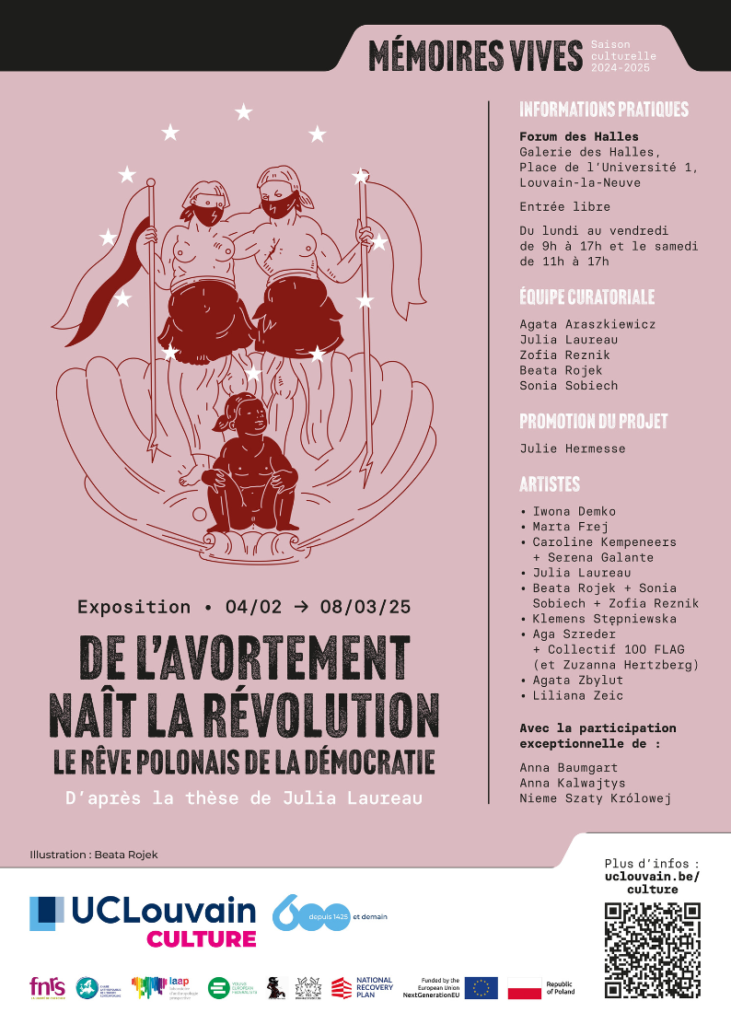
An exhibition of contemporary feminist art, “De l’avortement naît la révolution. Le rêve de la démocratie polonaise”, at UCLouvain in Louvain-la-Neuve, accompanying Julia Laureau’s doctoral research, “Is revolution a woman? Abortion, nationalism and democracy. An ethnographic portrait of women as political subjects in Poland (2020–2023).
Curatorial collective: Agata Araszkiewicz, Julia Laureau, Zofia Reznik, Beata Rojek, Sonia Sobiech
Artists: Iwona Demko, Marta Frej, Zuzanna Hertzberg, Caroline Kempeneers+Serena Galante, Julia Laureau, Beata Rojek + Sonia Sobiech + Zofia Reznik, Kle Mens, Aga Szreder + Collectif 100 flag (Agata Araszkiewicz+Katarzyna Bratkowska+Pomme Soltyk+Oskar Soltyk, Anka Leśniak, Karolina Freino, Marta Skuza, Agnieszka Bałucik + Ada Zawadzka+Adrian Kruszewski+Aleksandra Kołodziej+Katarzyna Chrobak+Kinga Kawalerowicz+Maria Dutkiewicz)
With special participation by: Anna Baumgart, Anna Kalwajtys, Nieme Szaty Królowej
About the exhibition:
The struggle for abortion rights in Poland is a dynamic arena in which both women’s rights and democracy itself are at stake. The history of people who can become pregnant seeking full self-determination is intertwined with contemporary art, which is deeply engaged in that struggle. At its centre is the powerful agency of Polish women’s protests: for the first time in the country’s modern history, women asserted their rights so forcefully.
The exhibition accompanies the research project of Julia Laureau, a doctoral researcher at UCLouvain (LAAP/FNRS), entitled “Is revolution a woman? Abortion, nationalism and democracy. An ethnography of women as political subjects in Poland (2020–2023)”. The project studies the Polish feminist struggle for abortion rights in its different forms, as well as the pro-life/anti-choice movement. It presents the researcher’s findings and field photographs and draws out the themes she examines through the work of invited contemporary Polish women artists. It traces both the political and intimate processes that led to the fall of the nationalist Law and Justice (PiS) government in autumn 2023, after eight years of rule which the exhibition’s authors describe as authoritarian and moving towards dictatorship.
The exhibition consists of two connected parts. The first focuses on resistance and subversion, showing how nationalism in Poland is shaped, experienced and challenged. The second is devoted to an “affirmative temple”, offering new ways of imagining abortion through representations of support and solidarity. Polish artists and activists do not work in a vacuum: initiatives such as Abortion Without Borders also exist thanks to support from the Belgian government, which was the first in Europe to establish a fund for Polish women travelling for an abortion. Although Belgium has long recognised the right to terminate a pregnancy on request and is considered to have a model reproductive healthcare system, abortion remains subject to social and cultural taboos there. Hence the continuing urgency of this exhibition: abortion rights as a central stake in feminism’s confrontation with populism are now a universal subject.
By bringing together researchers’ reflections, artists’ work and activists’ voices, we seek to draw attention to the different ways of discussing women’s experiences and representing the relationship between reproductive rights and democracy. We see Polish women’s voices and actions as especially important for contemporary democracy and for resisting fascist tendencies. We believe that, by bringing Polish and Belgian perspectives together, the exhibition will also encourage reflection on the situation of people who can become pregnant in other countries and on the state of human rights in Europe and around the world.